For years, retinol has been considered one of the most effective ingredients in skincare.
It stimulates collagen production, accelerates skin renewal, and improves signs of photoaging.
But there is always a trade-off:
❌ Skin irritation
❌ Redness
❌ Peeling
❌ Low tolerance for long-term use
So, the next breakthrough in anti-aging may not be about using more retinol…
It may be about making retinol work smarter.
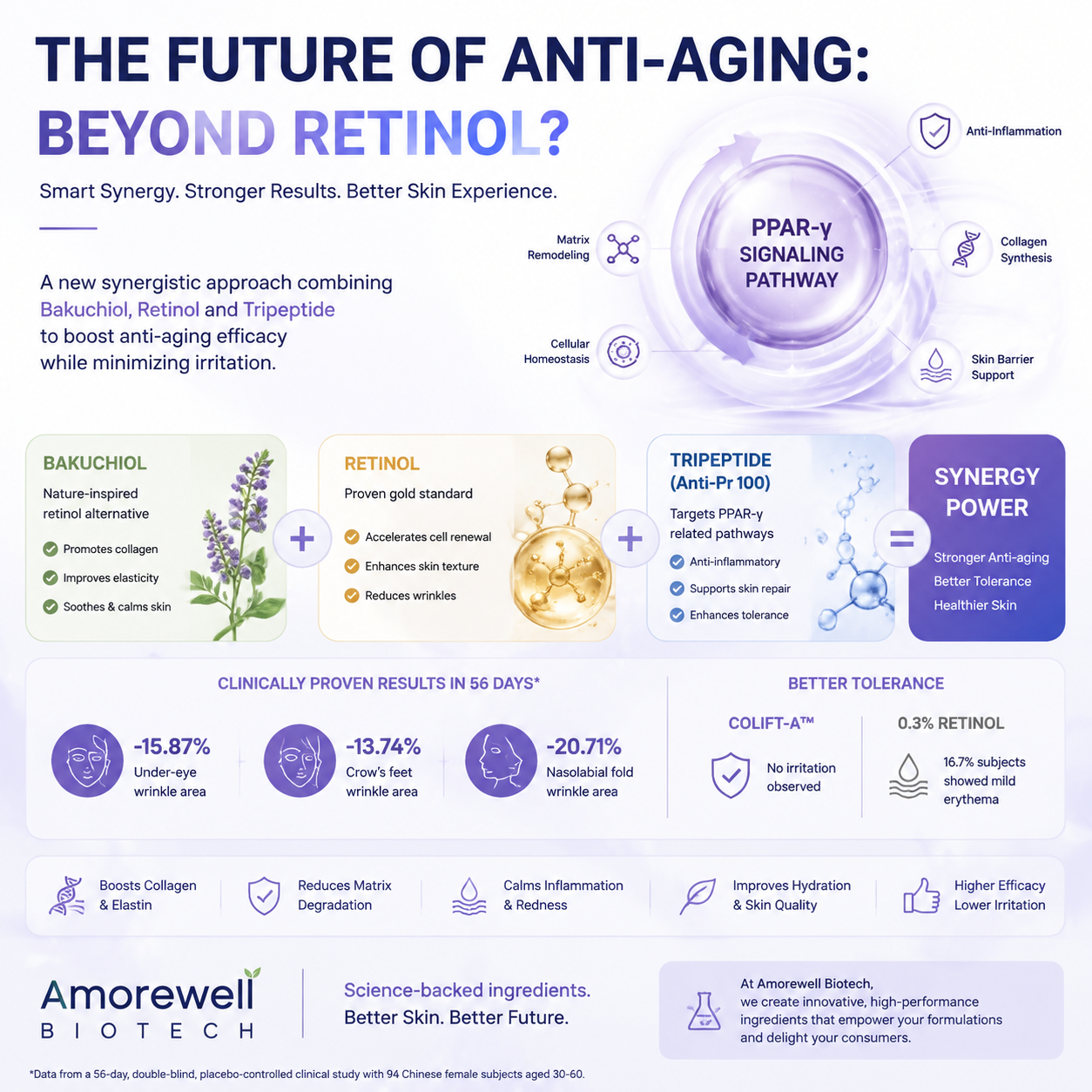
Recent research on a synergistic system combining:
🌿 Bakuchiol
✨ Retinol
🔬 Tripeptide (Anti-Pr 100)
shows an interesting direction:
Instead of replacing retinol, Bakuchiol can help optimize the retinol experience by improving skin tolerance while maintaining anti-aging activity.
The combination demonstrated:
✅ Increased collagen-related markers (COL1A1, COL3A1)
✅ Improved elastin-related expression (ELN)
✅ Reduced collagen degradation signals (MMP1)
✅ Regulation of inflammation-related pathways linked with PPAR-γ signaling
Even more interesting:
In a 56-day clinical study, the synergistic formula showed visible improvement in:
✔ Under-eye wrinkles
✔ Crow’s feet
✔ Nasolabial folds
while showing better skin tolerance compared with 0.3% retinol.
The future of anti-aging skincare may not be a competition between “natural” and “synthetic”.
It may be about combining different mechanisms to achieve higher performance with better consumer experience.
At Amorewell Biotech, we believe the next generation of cosmetic ingredients will come from:
Precision combination.
Mechanism-driven innovation.
Better balance between efficacy and safety.
💬 What do you think?
Will the future of anti-aging belong to:
1️⃣ Higher concentration actives?
2️⃣ Smart synergistic ingredient systems?
3️⃣ New biological pathways?
Let’s discuss.
#AntiAging #SkincareInnovation #Retinol #Bakuchiol #Peptides #CosmeticScience #BeautyTechnology #ActiveIngredients #SkinCareTrends